
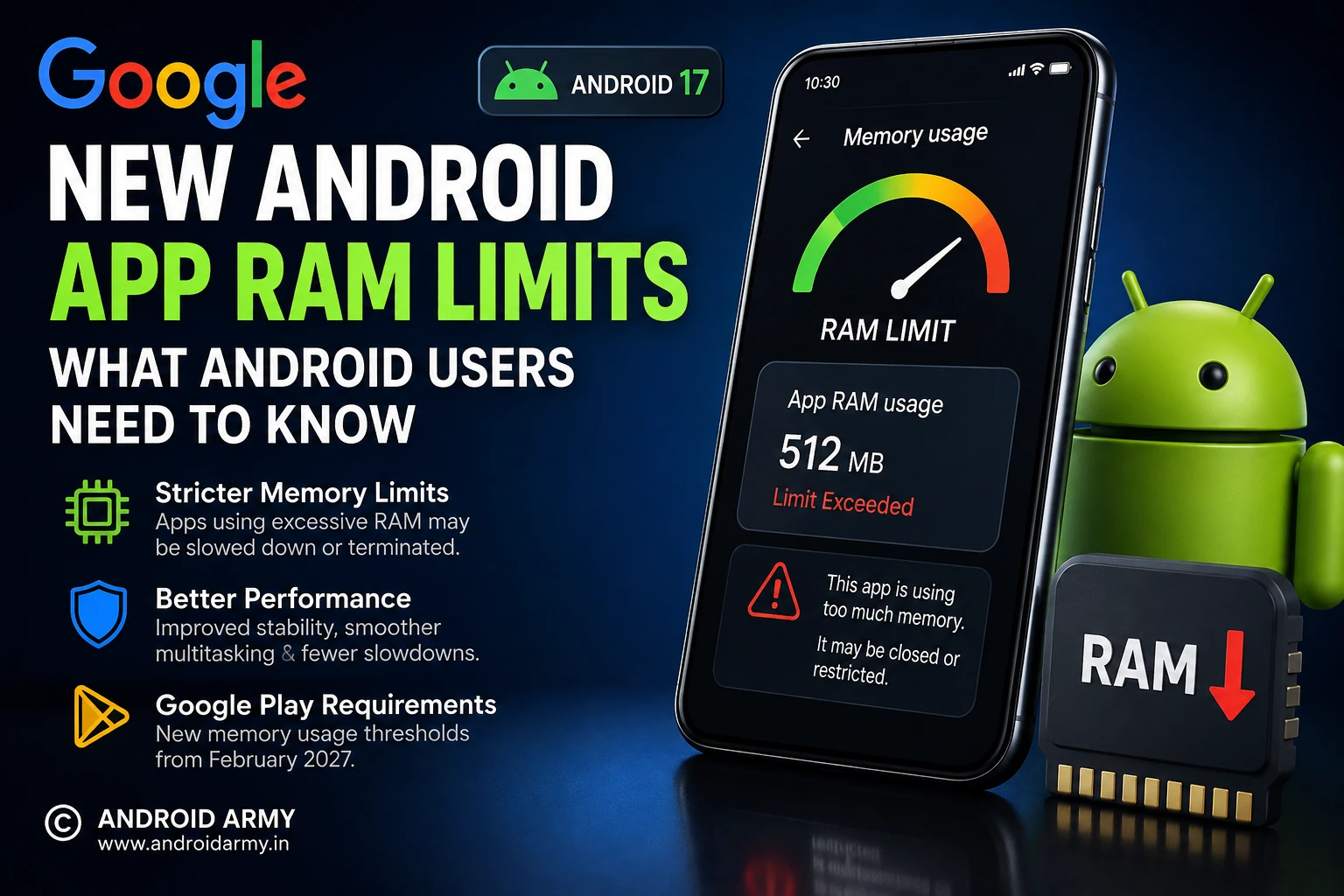
Google has officially announced new per-app RAM limits for Android devices, a move aimed at tackling what the company describes as an “ecosystem-wide memory crisis”. Starting in February 2027, apps that exceed these limits may be slowed down, terminated, or face reduced visibility on Google Play.
Here’s what the new Android app RAM limits mean for users, developers, and the future of Android performance.
What Are the New Android App RAM Limits?
The new system introduces per-app memory limits based on the total RAM available on a device. In Android 17, Google first introduced these limits starting with Pixel devices. Over the coming year, an increasing number of manufacturers will adopt the feature across devices with 4GB to over 16GB of RAM.
When an app exceeds its memory budget, Android takes progressive action:
zRAM Swapping: The system forces some of the app’s data into compressed RAM (zRAM). While this prevents immediate termination, compressing and decompressing data adds CPU overhead, which can cause noticeable UI stutter and slowdowns.
Process Termination: If the app continues to increase memory usage beyond the zRAM threshold, Android terminates it entirely.
Google Product Manager Blair Harmon explained that “a great user experience is central to Android’s mission,” and these measures help keep devices “fast, responsive, and reliable”.
How Much RAM Can an App Use?
The allowance depends on the device’s total RAM and whether the app process is visible to the user.
For an 8GB device, for example:
| Process Type | RAM Limit |
|---|---|
| Visible (foreground) process | 5GB |
| Non-visible (background) process | 3GB |
For a device with 8GB RAM, Google Play enforcement sets tighter thresholds:
| App State | RAM Limit |
|---|---|
| Foreground | 2.25GB |
| User-perceived services | 1.5GB |
| Background | 1.5GB |
Bitmap memory usage is capped at 200MB for user-perceived services and background states, and 400MB for cached states.
Google states that these thresholds are “deliberately conservative” — ordinary app sessions should rarely run into them.
When Do These Changes Take Effect?
The enforcement timeline is clear:
- February 2027: Memory usage enforcement begins. Apps and games must meet “bad behavior” thresholds for memory usage.
- April 2027: Zero-Tap Sign-In requirement takes effect for device migration.
Google is providing developers with tools in the Play Console to monitor memory usage, track crashes, and analyze code before the deadline.
Why Is Google Doing This?
The primary driver is the rising cost of RAM and its impact on device hardware.
Google’s Matthew Forsythe noted: “Memory is no longer just a background engineering detail — it directly impacts your app’s retention, crash rates, and user perception”.
Key factors include:
- RAM price increases are leading manufacturers to maintain or even decrease physical memory in new devices.
- User expectations for speed and smoothness continue to rise.
- On-device AI features are adding to memory demands.
- A single poorly optimized app can cause system-wide slowdowns and force the system to kill other well-behaving apps.
What Does This Mean for Indian Users?
The impact may be particularly noticeable in India, where the smartphone install base skews toward 4GB and 6GB RAM tiers. IDC put India’s average smartphone selling price at a record US$302 in Q1 2026, with memory costs climbing.
For users with budget and mid-range devices:
- Better overall performance: The system can contain a single memory-hungry app before it slows down the entire phone.
- Fewer unexpected slowdowns: Apps that exceed limits will be throttled or terminated rather than dragging down the whole system.
- More consistent multitasking: The measures help Android remain responsive when switching between apps.
Most users should not notice any difference during normal use, as Google expects ordinary app sessions to stay comfortably below these thresholds.
Will My Apps Stop Working?
For the vast majority of apps, no — they will continue to work normally. The limits are set to target “extreme memory leaks and other outliers” rather than well-behaved apps.
Google advises developers that if they optimize their apps, “they should not notice any difference initially”.
However, apps that are poorly optimized may:
- Run slower as the system moves data to zRAM
- Be terminated if they continue exceeding limits
- Face reduced visibility or publishing restrictions on Google Play
What Are Developers Required to Do?
Google has established performance thresholds across three areas:
1. Dynamic Memory Usage
Tracks anonymous RSS + swap memory used for private data storage, excluding code and asset files.
2. Bitmap Memory Usage
Evaluates memory consumed by bitmaps. Bitmaps should not be held in memory for extended periods in background or cached states.
3. Optimized DEX Code
Apps must achieve at least 25% coverage across optimization, shrinking, and obfuscation using tools like R8.
Google is also providing new diagnostic tools in the Play Console to help developers analyze memory consumption precisely.
FAQ
What are the new Android app RAM limits?
Google is introducing per-app memory limits in Android 17 that cap how much RAM an individual app can use based on the device’s total memory. Apps that exceed these limits may be slowed down or terminated.
When do the new RAM limits take effect?
Enforcement begins in February 2027. Apps and games must meet the new memory thresholds by then or face reduced visibility and publishing capabilities on Google Play.
Will the new RAM limits affect my phone’s performance?
For most users, no significant difference should be noticeable during normal use. The limits are designed to catch extreme memory hogs before they cause system-wide slowdowns.
Which devices are affected?
The limits will apply to devices with 4GB to over 16GB of RAM across an increasing number of manufacturers.
Will my apps stop working?
Well-optimized apps will continue to work normally. Only apps with extreme memory leaks or poor optimization are likely to be affected.
Why is Google doing this?
Rising RAM costs are leading manufacturers to maintain or reduce memory in new devices. Google wants to prevent a single poorly optimized app from ruining the experience for everyone.
1 thought on “Google Announces New Android App RAM Limits: What Users Need to Know”